
- New DIFT Colloquium “Can AI Save or Destroy the Planet? The Sustainability Challenge Behind Artificial Intelligence” by Paolo Dini
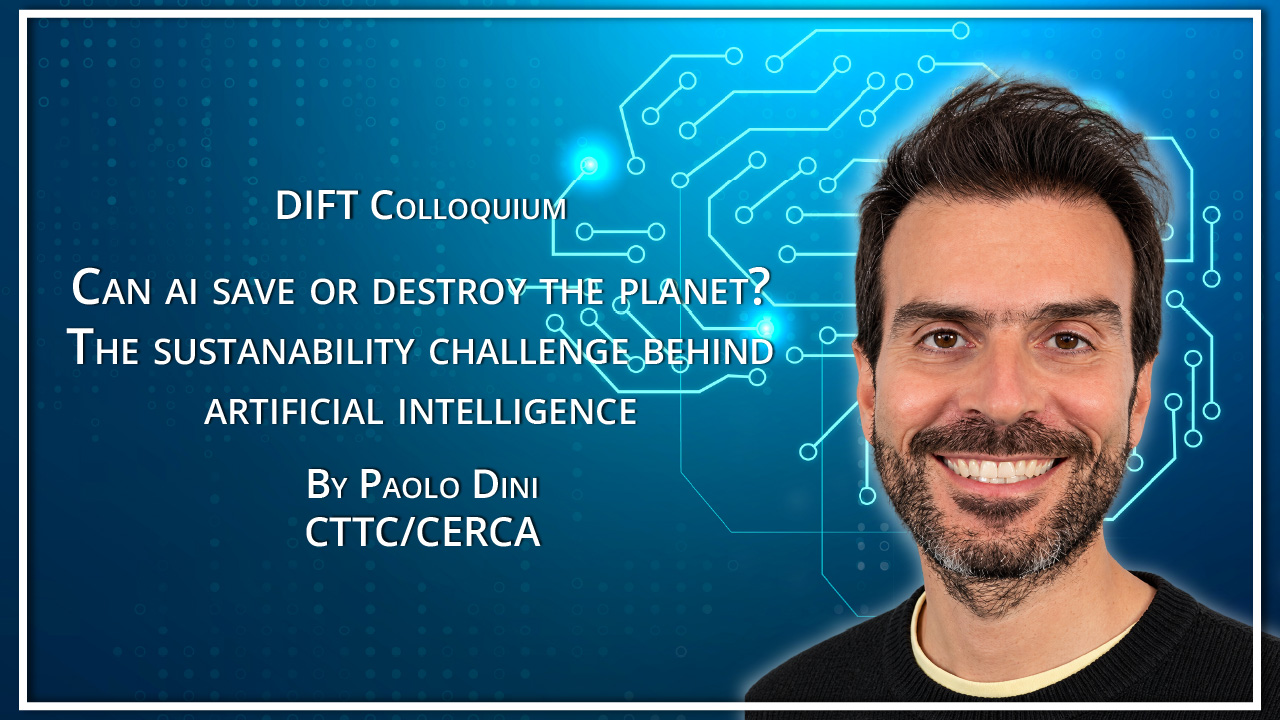
On Thursday, October 15, the Institute for Theoretical Physics (IFT) and the Department of Theoretical Physics at the Universidad Autónoma de Madrid (UAM) held a new edition of the DIFT Colloquium, which took place in the CFTMAT Auditorium from 3:30 to 5:00 p.m. The lecture, titled “Can AI Save or Destroy the Planet? The Sustainability Challenge Behind Artificial Intelligence”, was delivered by Paolo Dini, from Centre Tecnològic de Telecomunicacions de Catalunya.
Artificial Intelligence is increasingly being presented as a powerful enabler of sustainability. From climate change mitigation and renewable energy integration to environmental monitoring, waste management, water conservation, disaster response, and pollution control, AI offers unprecedented opportunities to support more sustainable and resilient societies.
However, the rapid expansion of AI also raises critical questions. What are the environmental implications of having virtually unlimited computational power at our disposal? What is the real impact of AI on energy production and consumption? Can the benefits of AI outweigh the growing demand for data centers, computing infrastructure, and digital resources? And what technological and organizational foundations are needed to ensure that AI itself remains sustainable?
This talk will explore the dual role of AI as both a tool for sustainability and a source of environmental and societal challenges. It will examine the energy, infrastructure, and resource requirements behind modern AI systems, discuss emerging approaches for reducing their environmental footprint, and reflect on how research, industry, and policy can contribute to the development of truly sustainable AI.
📌 This lecture is part of the DIFT Colloquia 2026, organized by the Department of Theoretical Physics at the Universidad Autónoma de Madrid and the Instituto de Física Teórica (IFT UAM-CSIC). Held in Madrid on October 15, 2026.