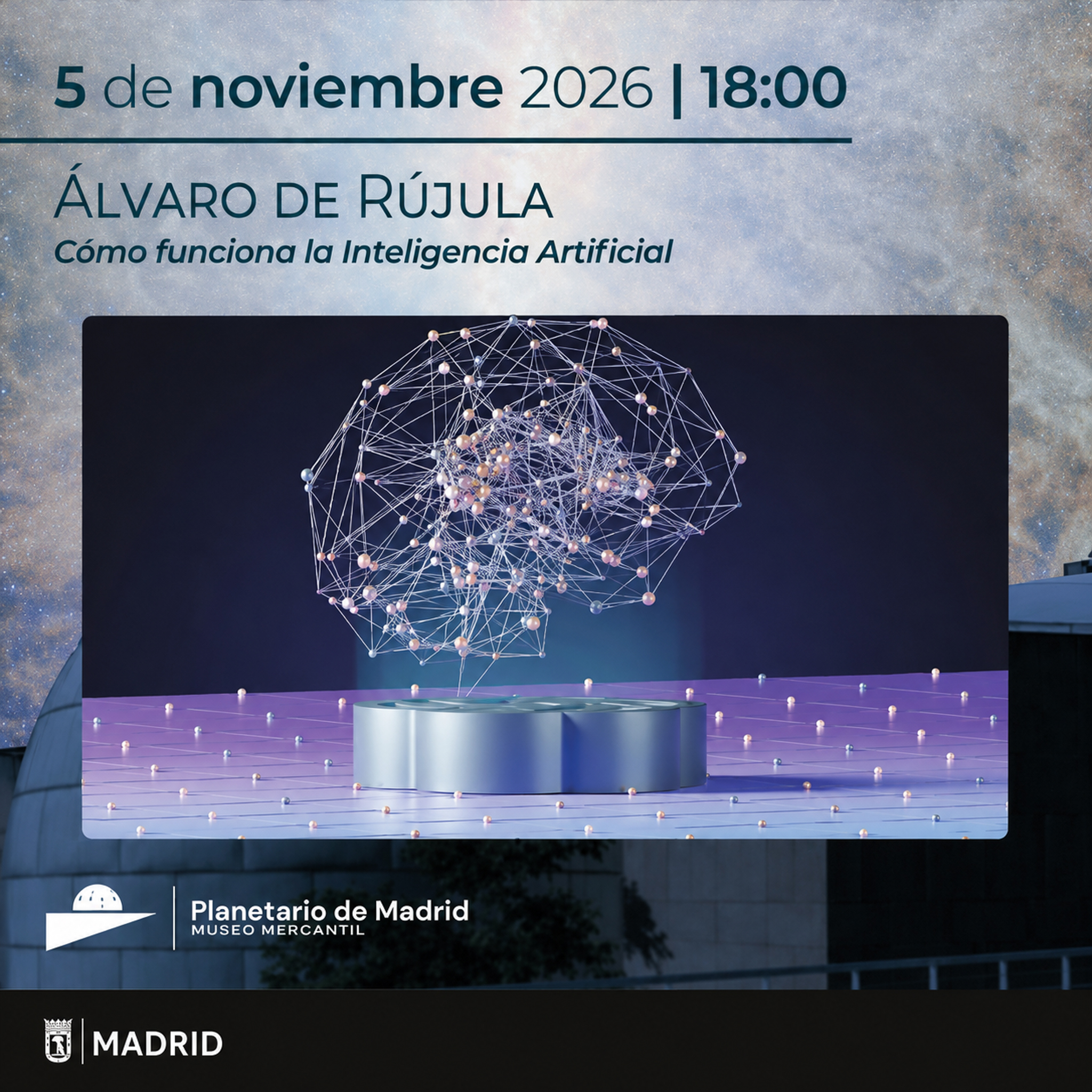
- Álvaro de Rújula, a researcher at the Institute for Theoretical Physics (IFT UAM-CSIC), will give a lecture titled “How Artificial Intelligence Works” at the Madrid Planetarium on Thursday, November 5, at 6:00 p.m.
Artificial intelligence occupies an increasingly significant place in our lives, frequently appearing in headlines, debates, and technological advancements. Yet, do we truly know how it works? Do we understand the mechanisms that allow these systems to learn, process information, and generate responses? And are we capable of anticipating their potential consequences?
These are some of the issues that Álvaro de Rújula will address in this lecture, in which he proposes looking beyond the news about artificial intelligence to reflect on one of the most significant technologies of our time. As the researcher himself points out, while we know how to program artificial intelligence systems to make them function, important questions remain regarding how they actually operate and what we can expect from their evolution.
Álvaro de Rújula is a researcher at CERN and an emeritus member of the Institute for Theoretical Physics (IFT UAM-CSIC). He is one of the most internationally prominent Spanish theoretical physicists, with a distinguished career in particle physics. He has spent a significant part of his career at CERN, where he contributed to major breakthroughs in the development of the Standard Model and the commissioning of the Large Hadron Collider (LHC). He has also held professorships at universities such as Harvard and Boston, and is well-known for his work in scientific outreach.
The lecture will take place in person at the Planetarium of Madrid’s Projection Hall and can also be followed live via the Planetarium’s YouTube channel.
Date: Thursday, November 5, 2026
Time: 18:00–19:30
Location: Madrid Planetarium
Broadcast: Madrid Planetarium YouTube channel
More information: Madrid Planetarium – Lecture: “How Artificial Intelligence Works”