- This event has passed.
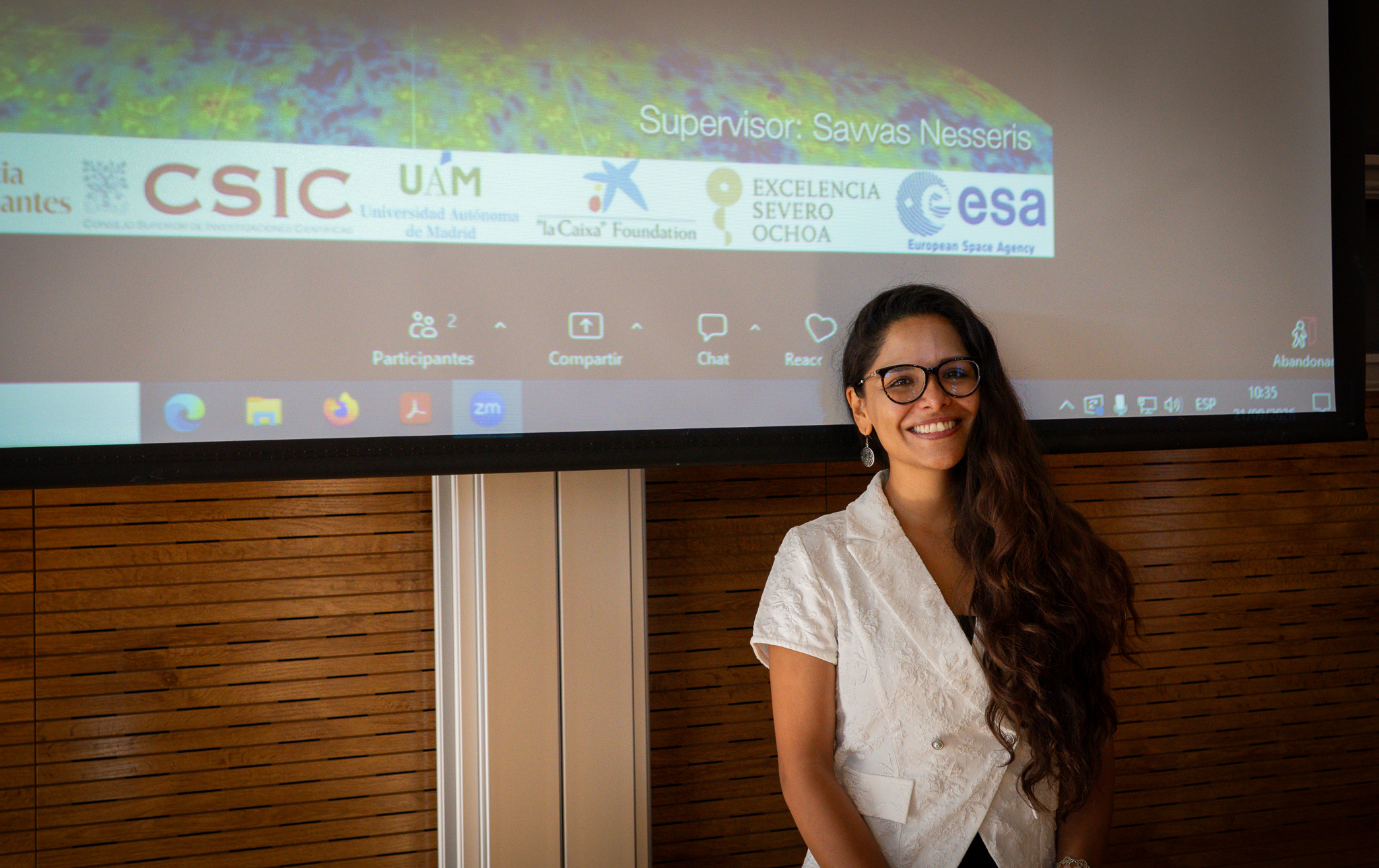
PhD Defense by Indira Ocampo Justiniano: A machine learning approach for unraveling the nature of dark matter and dark energy
Title: A machine learning approach for unraveling the nature of dark matter and dark energy
Venue & Time: Orange Room / 11:00-13:00
Abstract: Cosmology nowadays is benefiting from an exponential increase of data, transforming into a precision science. This will help us understand better two of the most important open issues in theoretical physics, namely understanding the nature of dark matter and dark energy. However, the vast quantity and quality of the data collected from present and upcoming cosmological surveys has become so demanding, that sophisticated computational tools are required. As a result, machine learning methods are being implemented for data analysis and model constraints with the hope of alleviating tensions in the parameters inferred from different cosmological probes. A significant challenge remains in the complexity of these models: as architectures become more accurate, this usually comes with the trade-off of their interpretability. This can lead to a lack of transparency and trustworthiness in a field that demands validation based on physical laws. The research presented in this thesis focuses on different architectures based on neural networks to search for signatures of physics beyond ΛCDM, with a particular emphasis on interpretability tools that allow extracting the most informative data for the model’s predictions.
Supervisor: Savvas Nesseris
A small reception will take place afterwards on the terrace of IMDEA around 13:00.